
Elizabeth Heyrick and the Nineteenth-Century Abolitionist Debate
Elizabeth Heyrick (1769–1831), a central figure in early nineteenth-century England, established herself as one of the most radical and innovative voices in the abolitionist debate, standing out for her firm stance in favour of the immediate abolition of slavery, openly breaking with the prevailing gradualist approach. With a vigorous, emotionally charged style, marked by tones of indignation, accusation, and at times sarcasm, Elizabeth Heyrick transforms her writing into a direct appeal to the moral conscience of the reader, advocating for immediate emancipation based on principles of justice, rationality, and humanity.
Writing, Activism, and the Awakening of Female Critical Thought
Elizabeth Heyrick’s literary production went beyond mere denunciation, contributing, alongside many other female writers, significantly to the awakening of female critical thought by encouraging women to take a stand on crucial issues such as slavery and social justice. Convinced of the decisive role women could play in the public sphere, Elizabeth Heyrick attributed to them a genuine ‘moral mission’, capable of legitimizing political action even outside the domestic sphere. This perspective is maintained in her subsequent pamphlets, Appeal to the Hearts and Consciences of British Women and Apology for Ladies Anti-Slavery Associations (both 1828), in which she urged British women to speak on behalf of the oppressed and to participate actively in the abolitionist struggle, including through concrete measures such as boycotting West Indian sugar. Elizabeth Heyrick’s trajectory shows how writing could become a tool of political persuasion and a privileged means of gaining a public voice in a context that tended to exclude women from civil debate.
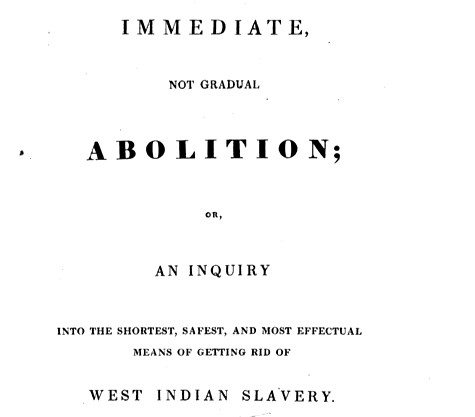
In this context, Elizabeth Heyrick interpreted her role as a reformer not only through activism but also through writing that rejected all political and moral compromise. In Immediate, Not Gradual Abolition (1824), she stood in stark contrast to William Wilberforce’s gradualist approach, calling for the immediate cessation of slavery and giving rise to the Immediatism movement. Her thought overturned the paternalistic logic of the era and assigned to every citizen, particularly women, the possibility of intervening directly through strategies such as boycotts, with a lasting influence on the American abolitionist movement.1
Elizabeth Heyrick played a decisive role in founding women’s societies such as the Female Society of Birmingham and the Leicester Ladies’ Antislavery Society, which challenged the restrictions imposed on women in the public and political sphere and achieved concrete results, such as boycotts of slave-produced sugar. Her writings inspired activists like William Lloyd Garrison and numerous female associations and activists, including figures such as Lucretia Mott. Elizabeth Heyrick claimed women’s active role, arguing that true power for change lay in individual action and, economically, in women’s power as domestic consumers. In this way, her strategy allowed women to circumvent limitations on female participation and assert the legitimacy of women’s political activism.2
Immediate, Not Gradual Abolition: The Rejection of Compromise
Elizabeth Heyrick strongly criticizes gradualism, considering it useful only to the interests of slave owners and a cause of delayed justice. As the ‘veil of ignorance’ has now been lifted, she calls for a clear choice: ‘the whole nation must now divide itself into the active supporters and the active opposers of slavery’.‘3 The use of ‘we’ engages and holds the reader accountable: ‘We are all guilty […] of supporting and perpetuating slavery’.4 She advocates boycotts, especially of slave-produced sugar, as the only effective response, describing gradualism as ‘the very master-piece of Satanic policy’.5 Elizabeth Heyrick exposes the deceit, created to allow the British government to profit, that enslaved people would be incapable of managing their freedom, noting that ‘No instance has been recorded […] of the immediately emancipated slaves having abused their freedom’,6 and condemns all political compromise: ‘let us no longer compromise the requisitions of humanity and justice.7
The destruction of family ties was one of the cruellest weapons of the slave system: men and women saw their children and spouses taken away with no possibility of reunion, generating rebellion and despair. Elizabeth Heyrick also denounces the inconsistency of the British elites: while they support the freedom of the Greeks in revolt against the Ottoman Empire, approving their insurrection, colonial slaves suffer brutal punishments. As she writes: ‘We extol the resistance of the Greeks, — we deem it heroic and meritorious… who sanction and approve the visitation of West Indian slave insurgents, with the GIBBET, and the infliction of one thousand lashes!!’8
The pamphlet concludes with an appeal to the sceptical: even if boycotts did not produce immediate tangible effects, they remain a morally just and necessary act to fight slavery.
Convergences in Nineteenth-Century Female Abolitionist Writing
Elizabeth Heyrick, Harriet Martineau (1802–1876), and Fanny Kemble (1809–1893) represent three different but complementary approaches to nineteenth-century female abolitionist writing. They are united by the goal of denouncing slavery, yet distinguished by their approach, style, and political-moral stance. Comparing them highlights not only the diverse strategies of opposition to slavery but also the multiple ways women could intervene in public debate.
Elizabeth Heyrick embodies the most radical form of activism: her writing is direct, accusatory, and oriented toward immediate action. For her, abolition is not a subject for analysis but an urgent moral necessity.
By contrast, Martineau, in Society in America (1837)9, adopts a detached and analytical approach, observing slavery as a social and structural phenomenon within a broader system of inequalities that intertwine gender, race, and class. Her methodological rigour allows her to expose the contradictions of American democracy.
Kemble occupies a different plane: in Journal of a Residence on a Georgian Plantation (1863)10, she privileges the subjective and diary-like dimension, offering an intimate testimony of plantation life. Unlike Elizabeth Heyrick and Martineau, her denunciation is initially hesitant, conditioned by family and marital contexts, yet this very tension makes her account a powerful tool of moral revelation. Through pathos and the immediacy of lived experience, Kemble exposes the brutality of the slave system and its psychological consequences, both for enslaved people and for the white women involved.
The decision to analyze Elizabeth Heyrick, Martineau, and Kemble aims to restore visibility to female figures often marginalized in the literary canon and to highlight their contribution to female emancipation and the defence of those without voice or social representation. As Midgley (1992) and Ferguson (2004)11 note, female abolitionists operated in historical contexts that marginalized them, yet their writing became a vehicle for ethical and political mobilization.12
In this way, the three writers transform writing into a tool of resistance, emancipation, and social change, creating a female abolitionist tradition of significant historical, literary, and theoretical relevance.
Footnotes
1. DeHart, V., Elizabeth Heyrick, Mother of Immediatism, The Women’s Print History Project, 16 July 2020, https://womensprinthistoryproject.com/blog/post/27, accessed 11 February 2025.
2. Birmingham Dispatch, The Lighting of the Fuse: How Birmingham’s All-Female Abolitionist Group Helped to End Slavery, 7 July 2024, https://www.birminghamdispatch.co.uk/the-lighting-of-the-fuse-how-birminghams/, accessed 11 May 2025.
3. E.C. Heyrick, Immediate, Not Gradual Abolition: Or an Inquiry into the Shortest, Safest, and Most Effectual Means of Getting Rid of West Indian Slavery, Philadelphia, PA, Philadelphia Ladies' Anti-Slavery Society, 1836, 4.
4. Ibid.
5. Heyrick, Immediate, Not Gradual Abolition, 9.
6. Heyrick, Immediate, Not Gradual Abolition, 7.
7. Heyrick, Immediate, Not Gradual Abolition, 20.
8. Heyrick, Immediate, Not Gradual Abolition, 22.
9. H. Martineau, Society in America, vol. I, New York-London, Saunders and Otley 1837.
10. F. A. Kemble, Journal of a Residence on a Georgian Plantation in 1838–1839, New York, Harper & Brothers, 1863.
11. M. Ferguson, , Subject to Others: British Women Writers and Colonial Slavery, 1670–1834, Routledge, New York, 2004.
12. C. Midgley, Women Against Slavery: The British Campaigns, 1780–1870, London: Routledge, 1992.
%20-%20(MeisterDrucke-177377).jpg)