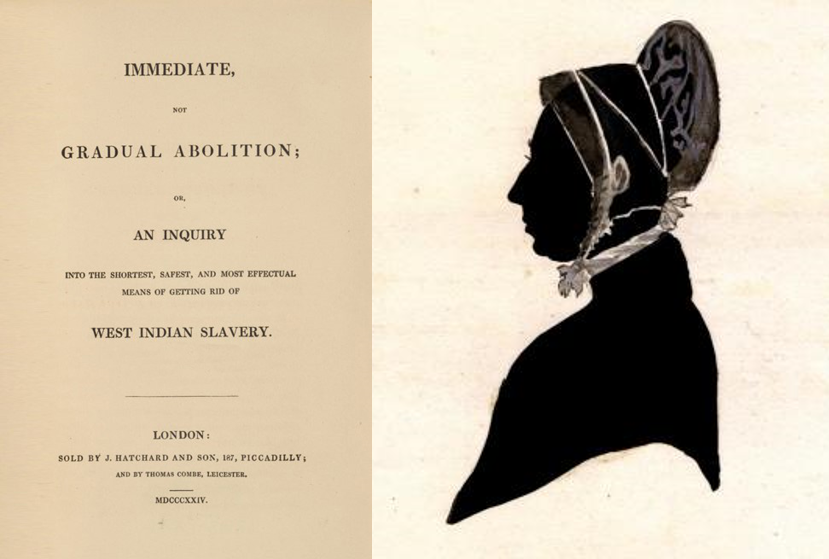

From the very outset of my engagement with and teaching of British abolitionist sources at the University of St Andrews, Elizabeth Heyrick’s Immediate, not gradual abolition (1824) caught my eye as highly relevant due to its focus on the individual’s agency in remedying systemic injustices. Although Heyrick published the pamphlet anonymously for a general audience, she introduced arguments that she later developed in writings directed specifically to British women. In these works, she urged women to take intellectual and practical action from within their own domestic sphere on behalf of enslaved British subjects. Her focus on the need for “immediacy” underlies this demand. Immediacy as an originally apolitical concept that is contemporarily applied to political intervention in societal issues such as the climate crisis, dates back further than the eighteenth century. We encounter it, amongst others, in the apocalyptic thought of the followers of the Radical Reformation from the sixteenth century onwards where it was coined as a reformatory reaction to societal crises propelled by ongoing warfare in Europe and its dire consequences, including famine, disease, high childhood mortality, etc. The destructive consequences of human action needed to be counterbalanced by another type of human action, meaning a reformatory kind of action, or reaction, that was directed by the will of a just and benevolent God, who communicated with humans receptive to it in an “immediate fashion”, rather than the will of man who continued to live in “resemblance with Adam”, meaning tainted by original sin and its destructive consequences. Following her conversion to Quakerism, Elizabeth Heyrick saw herself as one of those elected humans who stood in immediate communication with the divine will and able to act on it.
In the course of history from ancient to modern times, ideas of divine justice experienced an immense change, and still people disagree on what it entails. Different aspects of God that can be found in monotheistic religious writings, provide different ideas of justice. To anti-slavery activists, two of them are crucial: the first one is “retributive justice” that is enacted to repay acts of human injustice, such as slave-holding, and which played out in form of slave revolts; the other one is “restorative justice” which relates back to the act of redemption that is attributed to Christ. “Resemblance with Christ” as the main actor of human redemption, in fact, played an important role in the immediatist intellectual framework whose Christology was highly influenced by early modern Christian engagement with medieval Jewish and Muslim philosophy, notably Kabbalism and Averroism. Christian Kabbalism, especially, propagated a form of human action directed at repairing the world according to the precepts of divine restorative justice (what is known in Jewish philosophy as tikkun olam). Elizabeth Heyrick embraced this outlook. Her concept of immediacy was grounded in “immediate” restorative action which she identified with the boycotting of slave-grown products as a tool for collective reformative action. Even though she underlined that it was from within the individual that the process of redemption began, Averroism’s concept of the “unicity of the (human) intellect” aided her in the development of a view on individual redemption as deeply intertwined with universal redemption. One person in British society boycotting would not achieve much; however, if this person could convince others to join her and the convinced, on their part, could convince more persons, boycotting would soon become the new societal standard. Just like Christ, as religious reformer, had merited redemption for all humans due to his following the divine will in the act of self-sacrifice, Heyrick and other anti-slavery activists, through imitation of Christ’s reformative action, could do the same, notably by disseminating correct ideas about the incompatibility of divine justice with the institution of slavery. To Heyrick, Christianity was not “a voluminous code of arbitrary commands and prohibitions, but a system of principles, few in number, but of universal application” grounded on “the supreme love of God, each other, and ourselves” (Apology for Ladies’ Anti-Slavery Associations, 8-10). Following the anti-slavery legal pioneer Granville Sharp, Heyrick made a connection between the divine law (the Christian Golden Rule), which Sharp’s Kabbalistic-inspired Biblical exegesis had associated with the so-called Jubilee, a Biblical law prescribing slave emancipation (Leviticus, 25:8-55), and the idea of universal redemption. Even though Heyrick had advocated for abolitionists to turn their backs on “man-made” politics, in the backdrop of the political reform movement in Britain in the 1820s and 1830s, certain immediatist demands became incorporated into imperial legislation. The abandonment of the apprenticeship system by the later 1830s gives additional testimony to immediatism’s political viability. Back then as it is now, immediacy tends to spark controversy in political debate. However, it should not be underestimated as an effective tool in creating awareness for urgency (and a consequent propelling to action) in the resolving of political and societal crises, notably if they have become systemic.
%20-%20(MeisterDrucke-177377).jpg)