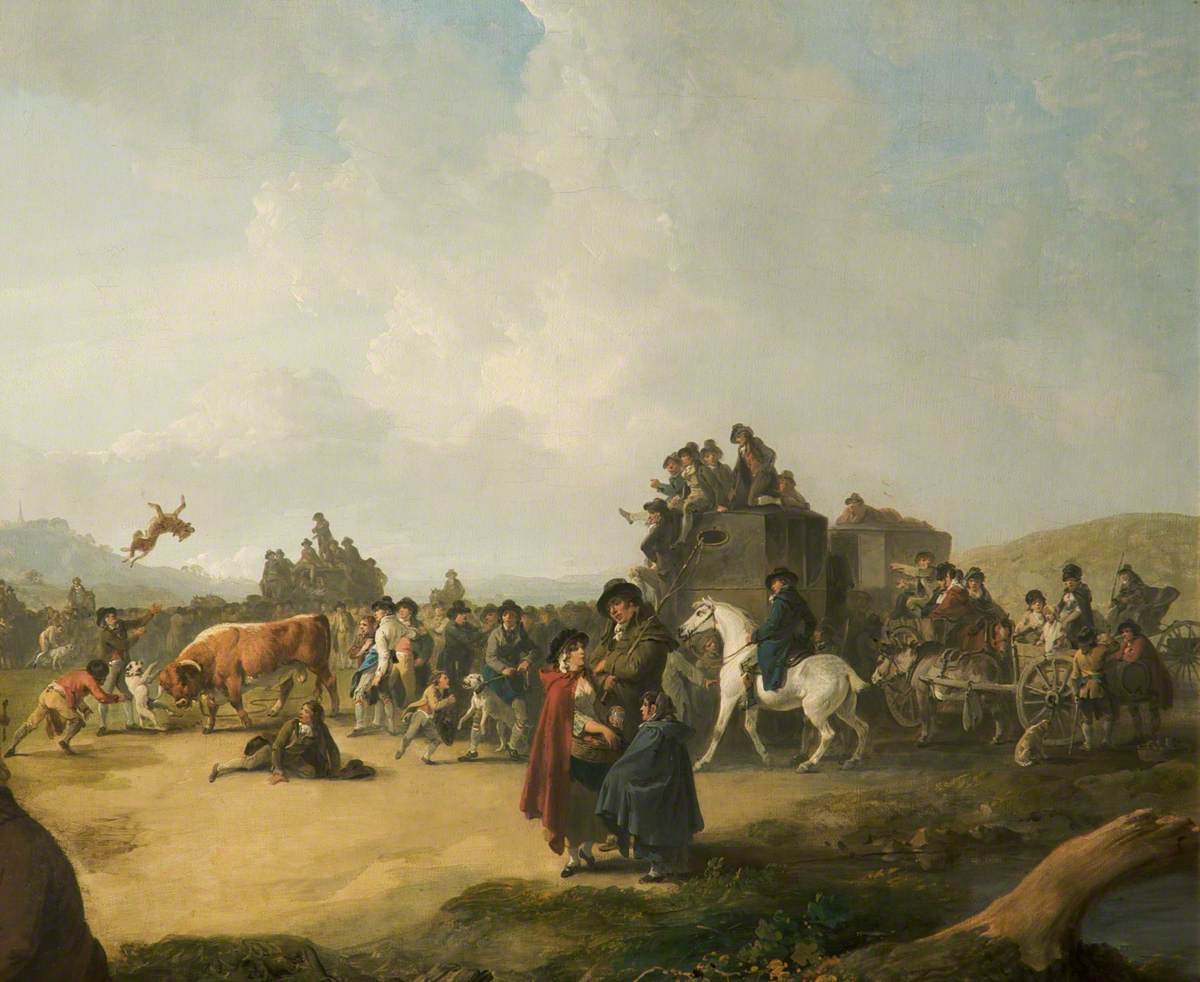

His[the bull’s] body was covered all over with wounds, and his head was so tornand mangled that it appeared nothing but a frightful, unformed mass of blood,from which the mingled flesh and gore hung, like thick icicles, quite to theground. And all this to afford pleasureto the lords of the creation!! (Bull-baiting:A Village Dialogue between Tom Brown and John Sims, 1809, p.10.)1
With such vivid words and unflinching eye, Elizabeth Heyrick described the spectacle of a bull subjected to baiting and expressed her disgust at the humans who had participated in the sport. In this and a companion pamphlet, Bull-baiting: A Christmas-Box, for the Advocates of Bull-baiting, also published in 1809, she set out arguments on religious, moral and social grounds against the practice.
It was something she was familiar with. The sport seems to have remained popular over a broad swathe of the English East Midlands (which cover Leicester) until into the first two decades of the nineteenth century, despite general sentiment gradually turning against it. In the summer of 1809, Elizabeth Heyrick took a direct stand against baiting when she visited the annual ‘wake’ in Bonsall in Derbyshire.2 A bull had been provided for the villagers’ entertainment. Remonstrating with local authorities and then with the villagers to abandon the baiting was of no avail. Using the power of money, she then bought the bull from its owner and led it to safety, to the frustration of the onlookers. The episode, while providing material for her first two pamphlets, demonstrates some of her outstanding qualities: personal courage, insistence on personal observation and exposure, practical responses to a situation.
Christmas was one of the seasons for bull-baiting. Another occasion for the sport was provided by the village ‘wakes’. In Elizabeth Heyrick’s time, these annual village holidays were still centred around the name-day of the patron saint of the local church.3 They started with a religious commemoration of the saint’s day, then moved on during the following week to popular festivities and drinking and sometimes entertainments such as baiting a bull or a bear with dogs. The local publican might be called on to bring in an animal. The creature might be chained to a stake, with its snout or neck the target for the dogs’ attacks. An enraged bull delighted the spectators, who might put pepper or firecrackers up its nostrils to goad it toa frenzy. Elizabeth Heyrick was not alone in finding such sport abhorrent. Local clergy were also seeking to curb their parishioners’ taste for such spectacles and preached against the practice in their sermons at the opening of the week’s holiday; for their pains, they and others who sought to intervene were complained of as spoil-sports and “meddlesome busy-bodies”.
In society at large, opinion was beginning to turn against the harsh treatment of animals and was leading to action. From 1800onwards, three successive bills were laid before parliament for the suppression of bull-baiting and more generally of cruelty towards animals, but were narrowly defeated. In 1822, an act directed against the cruel treatment of cattle was passed, though it did not include bull-baiting. Certainly, the horrific conditions in which cattle and sheep were brought to market, as at Smithfield in central London, were arousing revulsion, in which Elizabeth Heyrick herself joined in her pamphlet of 1823, Cursory Remarks on the Evil Tendency of Unrestrained Cruelty; Particularly on that Practised in Smithfield Market. Again, she drew on direct observation, from a window overlooking the market on a Sunday evening as it prepared for Monday’s cattle day. In precise and graphic words, she described the din and confusion as sheep were driven into pens and cattle then herded into the carriageway surrounding the market, where they mingled with passing carts. The accompanying drovers continually used their goads to control the cattle. Elizabeth Heyrick, as she walked past a suffering animal, tried to remonstrate with a “pleading” expression, for a nearby drover to raise his weapon menacingly against her, as if he would have felled her “had he dared”.
Elizabeth Heyrick was aware of parliamentary attempts to legislate against animal cruelty. and mentions two such endeavours: a bill laid before parliament in 1809, which did not pass, and the 1822 Cruel Treatment of Cattle Act. Indeed, the timing of her pamphlets of 1809and 1823 on the subject suggest a link with these parliamentary initiatives. She conceded that the failure of the 1809 bill meant that the law still permitted bull-baiting and that devotees of the sport could still argue that the “law was on their side”. She judged that the 1822 Act was “ineffective”, pointed to the difficulties of reforming practices at Smithfield market and, as ever ready with practical suggestions, called for prohibition on the use of goads, improved administration and more vigour on the part of the inspectors already appointed. She appeared to accept the decisive role of government in bringing cruel practices to an end and even in 1809, was hopeful that the cause of “humanity and virtue in parliament would prevail. Her belief was vindicated when, in 1835, the Cruelty to Animals Act was passed. It included animal baiting in its scope, but came too late for Elizabeth Heyrick, who had died in 1831.
Elizabeth's true hope for reform, however, lay in persuasion and education of people’s attitudes within a moral and divine framework. God was not blind to the suffering of animals, she held. They were part of his creation, and he would exact punishment in the next life for the pain inflicted on them. To the argument that men would not be called to account for doing harm to “brutes” and “savage, cruel creatures” made for human use, she replied that while humans might have the power to abuse animals, they did not have the right to do so, whatever their claims of superiority. For her, as great an evil as the harm done to animals through baiting and other forms of cruelty was the deleterious impact the activity had on men’s minds. Released from moral restraint over animals, they might be led to vent their cruelty on their fellow humans in family and civil life.
The focus of Elizabeth Heyrick’s arguments and pleading would appear to have been those most immediately responsible for the cruelty she observed, such as villagers and drovers, placed among the lowest ranks of society. But while she regretted the ignorance and brutality of such people, she kept her fiercer chastisement for those in socially more powerful positions for their failure to lead by example and instruction. Those with authority to prevent cruelty in the markets should exercise their authority. Those in parliament should not indulge the “inclinations and passions” of the lower classes out of an “insulting” concern for their “pleasures” through obstructing legislation. Above all, the upper classes were guilty of a range of cruel practices: the exploitation of carriage horses (still used in the early nineteenth century to provide the most common form of transport) through driving them to exhaustion and the “nicking” or cutting of their tail muscles to make their tails stand higher; and sports such fox-hunting with dogs and horses, cock-fighting, horse-racing and boxing matches. Between these sports and bull-baiting, using the villager Tom Brown as her mouthpiece, Elizabeth Heyrick saw little to choose.
When she wrote her ‘Christmas-Box’ on bull-baiting in 1809, Elizabeth Heyrick clearly felt hers was a “single opinion” against the world. She was not alone, however, and popular views were changing. Her pamphlet of 1823 on conditions at Smithfield market has a more confident ring to it; and a year later, in 1824, a Society for the Prevention of Cruelty to Animals (SPCA)4 was founded in London with the support of Members of Parliament, lawyers, clergymen, writers, philosophers and others. Women appear to have been admitted as members from the outset, but we do not know if Elizabeth Heyrick subscribed to the new society. Her wariness around formal and official institutions may have led her to follow a more personal path. Neither do we know what her views were on the consumption of animals. She did not speak of ‘animal rights’ except for their right to compassion and not to be exploited, and it is unlikely she regarded them as the equals of humans.
Ideas approaching more closely to those of ‘animal liberation’ were being voiced in the early nineteenth century by such men as Lewis Gompertz (1783/4-1861), a philosopher, writer, inventor and campaigner for animal rights. He was a founding member of the SPCA and in the same year, 1824, published Moral Inquiries on the Situation of Man and of Brutes, but resigned from the SPCA in 1833 and founded the Animals ’Friend Society. His lifestyle would be familiar to modern vegans with abstention from all animal food and a refusal to use animal-drawn transport or wear clothes made from animal products.5
We do not know if Elizabeth Heyrick and Lewis Gompertz ever met; it is not implausible, though, that they may have read each other’s polemical writings. Their activism took different forms, but their passion for justice for animals was equal. Elizabeth’s taste for observation, protest and even intervention is picked up in the direct action of some modern campaigners. She would have made a superb journalist and activist if living today!
References
1. The three pamphlets cited in this article are contained in Pamphlets Written by Elizabeth Heyrick of Leicester, 1809-1828, ref. DE9081, the Record Office for Leicestershire, Leicester and Rutland.
2. For an account of this event, see Jocelyn Robson, Elizabeth Heyrick: The Making of an Anti-slavery Campaigner, Barnsley, South Yorkshire: Pen and Sword History, 2024, 67-71.
3. The term ‘wakes weeks’ to designate annual holidays for industrial workers came into use later in the nineteenth century.
4. The SPCA was awarded royal status in 1840, becoming the RSPCA.
5. See the Oxford Dictionary of National Biography, entry by Lucien Wolf, ‘Gompertz, Lewis(1783/4-1861), animal rights campaigner and mentor’, 2004, revised by Ben Marsden; Barry Kews, Lewis Gompertz: Philosopher, Activist, Philanthropist, Inventor, Eugene, Oregon: Wipf and Stock Publishers, 2023.
%20-%20(MeisterDrucke-177377).jpg)